
Is your business on course?

How’s your business doing? Do you know what’s missing? Start to find your way by answering a few questions and using tools that are focused on your goals.

Available Information

“Good Forever” Daily Deals

Have you been tempted to buy online coupons, called “daily deals”? They are offered for spa treatments, restaurants, “boot camps”, hair salons or any one of a huge variety of other tantalizing things for half price or more. Maybe you bought one but didn’t use it. Maybe you threw it away because you thought it expired.

Good news. You can still use it or at least get your money back. Do talk to the merchant because they really sold you a gift certificate, even if it were called a coupon by Groupon, Living Social, Google, Amazon or any of the other 40 providers in the Austin area or the over 500 providers nationwide.

It’s a good chance the spa, restaurant, bakery, etc. didn’t realize that this was a gift certificate. But, it is. You paid for it and under Texas and federal law it’s your property indefinitely.

Yes, indefinitely. If you paid for the coupon, it falls under Texas’ Stored Value Card Act and has to be treated just like any other gift certificate. So, like other gift certificates, the merchant has to honor it for five years.

If you haven’t used it in that time, it still belongs to you. But after five years, it falls under Texas’ Unclaimed Property Laws and the merchant has to turn over the total amount you paid to the Comptroller’s Office. Then the Comptroller lists it at https://txcpa.cpa.state.tx.us/up/Search.jsp and you can claim it.

This is not just true in Texas. There are federal laws, the Credit Card Accountability Responsibility and Disclosure (CARD) Act and the Electronic Funds Transfer Act, that make electronic coupons the permanent property of the purchaser. At last count, there were over 14 state class action suits against Groupon and 2 against Living Social related to this issue and deceptive trade practices. These suits include the merchants who used these “coupons” as a method to attract customers.

If you are a merchant and are considering using online coupons, you can learn more about your responsibilities by watching the Business Success Center’s YouTube video “Do No Harm with Daily Deals” at http://www.youtube.com/user/runitright#p/a/u/0/mmyXRmm2mAA.

If you are a consumer or a merchant with questions, please email me at triplett@runitright.biz. Ms. Lehman and I are also happy to give our presentation to any interested group. Just contact me.


Overcoming 5 Challenges to Keeping Your Head in Tough Times

What Goes Up Must Come Down

Sir Isaac Newton statue from Trinity Chapel. Photo by Harlequeen

Sir Isaac Newton proved it. David Clayton-Thomas wrote about it in the “Spinning Wheel” song. BS&T (Blood, Sweat & Tears) and Dame Shirley Bassey covered it in their albums.

Songwriter & singer Dame Shirley Bassey

How many ups and downs has your business experienced? Since we started our business, we have been through seven ups and downs – oil, banking, real estate, savings and loans, dot.com, Wall Street, and now real estate again. It has caused us to refine and redefine our business at least that many times.

If it’s a part life, it does not make sense just to try to survive this one because another wave is coming. If you own a business, the wave that could take you under could be something global like this “Great Recession” or something unique to you and your business. So be watchful; be prepared.

At the Business Success Center, we have identified five potential challenge areas that are always out there:

1. Economic

2. Environmental

3. Political

4. Social

5. Technological

What’s happening now? We are being hit by all of these all at once or so it seems.

What are people doing? Some are giving up and calling it quits. Some are digging in and just trying to survive  —  to just be able to “stay” in business. The successful ones are looking for ways to thrive.

What do you choose? Give up, give in, or stay in?

Keeping Your Head

Rudyard Kipling wrote his poem “If” in 1895 but it was not published until 1910. It’s a litany of actions to take to become a man (or woman). I think it’s also a useful guide on how to have a successful business no matter what is happening in the world outside or inside.

So how do you keep going when others are losing their way and people are blaming you?

It starts with confidence. This makes sense. After all, confidence in you (your product and service solutions, your staff, and how you do things) is the prime reason someone decides to buy something from you. No confidence, no sale — end of story.*

Step One: keep your head no matter what others are doing. Don’t just be confident you can survive, envision yourself as thriving. Pass on this confidence in your ability and skill to overcome any challenge that comes your way. Be confident in staff and customers, too. Confidence is contagious; spread it around.

Can you trust, wait, dream, think?

People buy from you because they trust you will provide them with the level of quality, service and selection they expect. Because you give them what they want not just what they need, they’re willing to pay your price and be glad it’s not more.

Owners who thrive in tough times are what authors Albert Bernstein and Sydney Rozen describe as “Believers” in one of my favorite books, Neanderthals at Work. It is an oldie but a goodie. (Buy it from your favorite local independent bookstore but they will have to order it.) This term does not have to do with a religious faith but in the thought that some people believe there is order, rules that matter and following those will make you successful and proud of it.

How do you demonstrate this?

You trust in yourself. You are willing to wait and see what happens. You think and plan ahead because the world turns and the best will rise again. You dream big and take actions that are counter intuitive to those who are quitters or just survivors.

What do you do, Little Red Hen? While Chicken Little** is saying the sky is falling, do you get out there and “Just Do It” ? Do you keep thinking how to work smarter not harder?

Here are some good “Thriver” choices. Dreaming, thinking and trusting are required.

1. You don’t cut prices or quality. You do contain your costs by setting up processes and systems that make you more effective and efficient. You may even raise your prices and get a better grade of customers.

2. You spend more on marketing. But you do it more efficiently. And, you do seek out alliances with other like-minded businesses and organizations.

3. You don’t cut back on staff. But you do get rid of the dead wood or at least rearrange that wood to light them up and get a roaring fire going instead of just fizzling out.

4. You become more selective in your customers. You go for the platinum and gold customers™ and dump the lead, concrete, and radio active waste customers™.

Risk Takers

“If you can make one heap of all your winnings
And risk it all on one turn of pitch-and-toss,
And lose, and start again at your beginnings
And never breath a word about your loss;”
(From “If” by Rudyard Kipling)

Banks, the government and non business owners think those of us who own small businesses are too volatile, too much of a risk taker. Just plain crazy.

I can tell you in working with owners of product and service businesses from accounting firms to zoos, we are the most risk adverse group on the planet. Any risk we are willing to take only happens after we have examined the other options and trust we can take an “informed leap of faith”.

If we guess wrong, then we usually start again. You can do that relatively easily in the US and even easier in Texas that is famous for being a “boom and bust state”.

In many parts of the world you “lose face” or even your life if you close your doors. By the way, even in tough times, most small business do not “fail” (close due to nonpayment of bills). They close the doors because the owners give up. They lose their dream, their trust and confidence in themselves, and their will to go on.

In the end, it’s your choice

As Kipling says,

“If you can meet with Triumph and Disaster
And treat those two impostors just the same;”

And

“Or watch the things you gave your life to, broken,
And stoop and build’em up with worn-out tools;”

And

“If you can force your heart and nerve and sinew
To serve your turn long after they are gone,
And so hold on when there is nothing in you
Except the Will which says to them: “Hold on!”

“Yours is the Earth and everything that’s in it,
And — which is more — you’ll be a Man, my son!”

You WILL always be a thriver, not just a survivor.

Author’s Notes:

*In experiments, researchers found they could influence the education outcome by telling the teacher ahead of time that a student was bad or good. Confidence does have consequences good and bad. We are talking here about honestly feeling positive about what you do for customers, your community, and others who count on you.

**If you are interested, the Chicken Licken or Chicken Little story comes from the Jataka Tales of Buddhist folklore not Aesop’s Fables and Little Red Hen is most likely a Russian folktale. I am confident that you will impress others with these bits of trivia and be well on your way to a more successful you.

Here’s to your long lasting success!

How do you thrive in tough times? Share your experiences. They could help the rest of us when we need a little inspiration.

3 Personal Networking Skills Every Introvert Has

Not the belle or beau of the ball? Don’t do well in groups? Are you kind of shy or just hate playing the networking game? You can still be a great networker. The best part is, you don’t have to and shouldn’t change you.

You do have to play by the rules. Networking is a balancing act; give and take. It’s not just about sales or prospecting. Although these can happen.  You can also use it for finding friends, jobs, fun places to go or avoid, and a million other things. Think about it as a combination of a “net” which gathers things in and keeps things out and a lot of hard “work”. Believe me, it doesn’t come easy to extraverts either although it may seem that way.

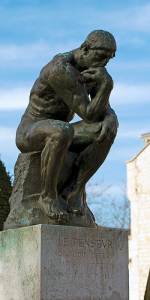
Rodin's "The Thinker" could have been named "The Introvert". Photo by James Whitesmith.

But you can play to your strengths and get great rewards. What are those? Most introverts I have known are great gathers of information and deep thinkers. When I did a session on Networking for Introverts at SXSW two years ago, I first wondered if anyone would show up. They did and all those introverts made me a true believer in their abilities. This depth means introverts have a lot to give. Most are good observers, intuitive, with great analysis skills. Hard work and thoroughness is central to how they operate. I recommend to every extravert, that they network with at least one introvert.

If you are an introvert, here are three abilities you already have that will make you a successful networker and a valuable member of anyone’s network. They are things you can capitalize on because your energy is focused on concepts and ideas. These are (or should be) highly prized by extraverts.

Number 1: Use your powers of observation and your inquiring mind to collect information that an extravert would find valuable.

Help us do the work. We’re not lazy but we do put our focus elsewhere usually.

We want to know about people and what’s going on because we want to always be in the know ourselves so we can share that with our network of people, We want to know enough about the “how” of things that we don’t appear unprepared or stupid. That doesn’t mean that a good, extraverted networker should steal your thunder and expertise. It does mean that generally, we like to learn. Help us and we’ll help you.

Number 2: Use your analysis skills to listen, read, and prepare for a meeting where your goal is networking.

At that meeting, share your news with the right people who need or want to know this. Not everyone will be open to this, but some will. Watch for them. Also include “Negative Networking” information in what you share. This is not gossip but does provide warnings about potential problems. These can range from things like places to avoid because of bad food or service to issues related to functionality of a product or even integrity of a firm. Extraverts, like everyone else, don’t like to make mistakes or give bad information to their network. That makes them less valuable in their own eyes and others.

Use social media and face-to-face in a way that is right for you. Be a lurker if you have to but then share what you learned. You may not be into Twitter but maybe you can be a commenter on other people’s blog posts. If you add value and seem interested and interesting, others will be interested in you. There are also online communities that post questions. If you can answer them, you will be someone’s hero or heroine.

Sometimes I think that social media was specifically designed by and for introverts. You get to share information to many people and you don’t have to wait for them to acknowledge your presence. This is a common complaint my introvert friends have about us extraverts, we seem to close ranks and it’s hard to get us to notice the introverts on the fringe of the conversation circle.

Be selective on where you go – there are always many ways to connect. Even if you hear that this is the place to be, it may not be the place for you.  Do your homework and find out if the group tends to be open or clique-ish. Don’t go and put yourself in that situation unless you can benefit from it. There are always other events and opportunities.

I once made a calendar of all the networking activities that I could attend in Austin, Texas. I could have found something at all times of the day and evening that would have been relevant. Good extravert networkers choose what to attend and so should you. The good news is you will probably see them again and again at events you attend. Even if you haven’t met them yet, you already have something in common. Networking is about connections and each one has value. Some more, some less. At least you can commiserate with us about some of the not so good meetings. Misery does love company at least from time to time.

If it’s a meeting you have to attend, your job is to collect information to give back to those who do value you. These people may or may not be there themselves. Be the organized observer and analyzer. Don’t worry about the others. Don’t worry about getting noticed and appreciated. If it works out that way great. At meetings where you feel out of place and are not welcomed, you aren’t going to change their opinion by trying to become an insider.

Be prepared before you go to the meeting. Do your homework on the subject to help you get the most out of it. I feel sure you will do this anyway but it has a big networking payoff. Equally important, see who will be at the meeting. Have a plan to find them. Approach them when they are by themselves. There are times when every extravert is solitary. It may be a fleeting moment. Watch for it and react. Extraverts don’t like to be alone for long.

Number 3: Use your intuitiveness.

Find an extravert who is open and receptive of the information and analysis you bring. You do a lot of the hard work that they need. This makes you as valuable to them as they can be to you. They open doors for you; you open windows for them.

Finally, everyone is an introvert from time to time. Some may just hide it better.

If it seems like I am being disrespectful of extraverts, I am not. Our focus is outwards towards people and things. I just recognize that we need a little help from our introvert friends to be our best.

There’s a good article about extravertism and introvertism from changingminds.org. Check it out at: http://changingminds.org/explanations/preferences/extravert_introvert.htm

What else can you add about introverts and extraverts?

Here’s to your success!


Leveraging Customers in Contract Negotiations

Sometimes big & small can work together. Photo by Daniel Voyager

My colleague, Dan Diener, was working with client who was re-negotiating an existing contract that was up for renewal. It ran into a snag because the contract was for a higher amount than the previous year in order to be in line with our client’s other contracts. This was crucial since our client provides personnel to others and significant benefits to his employees.

Our client, based in Austin, Texas, is a small business with a very large state client. Because of the nature of the industry and how these two organizations work together and share information, the decision was made to talk to the larger client about the situation. The result was a good rationale to stand firm on price by leveraging the larger client. Our client said no, he could not honor the same deal he had with the state client if he cut the price for this existing client. The contract was signed at the price our client proposed. Honor and ethics were well served as well.

This was an unusual situation. Frequently, a larger client wants a “discount” for the prestige of working with them. But, it can work in your favor when someone else wants the “discount”. Don’t feel you have to give in. Stand firm for your existing customers and leverage them when appropriate.

You can use this strategy also when dealing with Daily Deal coupon buyers who want more than they bought. You have negotiated a deal with an online coupon marketing company and you should stick to the deal. In a recent article Groupon Nightmares by Sarah Jacobson Purewal for Entrepreneur, she cites the case of Sound Roots, a music school in Oregon. When numerous people called to try to bend the rules and get more than the value of the LivingSocial coupon, owner Fara Heath, told her manager to say, “This is a very good deal, and take it for what it’s worth.”

7 Golden Sales Rules for Small Business

A great rewards program, based in Austin, Texas, to encourage people to buy locally.

I have just finished a five-hour sales training session for Go Local an Austin, Texas company that is licensing its program nationwide to encourage people to support their locally owned businesses and buy locally. This is a great marketing tool for businesses and reward system for new and existing customers. Even though some of the licensees had sales experience, their questions and concerns prompted me to put together this list of sales concepts that I consider critical to success.

It starts with agreeing with the first “golden rule”.

#1 Sales is all about giving the right someone an opportunity to buy what’s right for them.

Sales is not about “selling”, or about selling to any and every one, and that it is about selling to a real live person, not a company. If you want more sales conversions and more conversions bringing other converts, you may want to follow the other rules. These focus on getting more “gold” from each sales opportunity as well as set in motion after sales potential from “champion-advocate customers™”.

  1. Never take “No”, from someone who can’t say “Yes”.
  2. Be willing to tell a prospect (or an existing or former customer) that your product or service is “not right” for them or “not right for them at this time”. Honesty really has a huge payoff.
  3. Be patient. Most sales are made after the 8th contact. That doesn’t mean eight meetings necessarily. It can take you multiple tries to get a meeting or get one with the right person or persons.
  4. Your sales goal should be to go beyond customer satisfaction to customer passion. Passion makes people talk and want to share their good fortune. That turns your customer into your advocate or champion and makes the next sale easier and faster. I identify these people as “Champion-Advocate Customers™. They are extremely helpful when I need to give prospects someone to talk to who has been a client. They also send me referrals like them which I greatly appreciate.
  5. The best sales are face-to-face (or as I like to think of it “belly button to belly button”). Your business card, your website, and every other kind of advertising media stands in place of that. If you can see them, don’t miss the opportunity.
  6. You are always selling your company as well as your products and service. Good products do not out weigh a company that is badly run.
  7. And, this one is my absolute must. Have a proactive sales plan and then do it. If you are proactive, you don’t wait for prospects to call, you call on them first. To do it successfully, you need to do your homework. That means a Platinum Customer Profile™ to know whom you are looking for and identifying and selecting appropriate targets to go after. You have to go prepared knowing as much about them ahead of time as you can. When you are with them, listen, react to what they say, and ask questions based on what they said. Show them they matter. Don’t just sell, sell, sell.

Do you have sales rules for your sales staff? What helps you get and keep the right customers? I would love to pass your wisdom along to others.

I am very grateful for the people who have steered me in the right direction. Special thanks to Maury Coats (former head of the Texas Commission on the Arts and a great sales teacher), author Sharon Drew Morgen, and almost 30 years of the best clients one could ask for.

I want to encourage everyone who is interested in creating customer passion to consider attending the upcoming Usability Professionals Association International Conference on “Designing for Social Change” in Atlanta, June 21-24, 2011. I will be presenting a tutorial and a workshop on strategic alliances and attending as many sessions as I can. Usability issues can make or break a customer’s experience with your company, your website, and your products and services. You do not have to be a UPA member to attend, but you might want to join for the insights they can provide to make you more successful.

Want a Mentor? Look around you.

Business Success Center prospects tell us in their initial meeting they want a “Mentor”  to advise and guide them to solve a specific problem or achieve a specific goal.

I completely understand. I’ve had several wonderful mentors. My godmother, Northwestern University professor Alvina Krause, had “teas”. At these salons, I learned the fine art of  conversation. My grandmother taught me the importance of family. My mother  helped me find my voice and be comfortable being myself. She always said “we grew up together”.  Maybe so, but she was my guide.

There were important male mentors, too. My brother Bill (aka WC Triplett, II) has worked for Presidents and Senators, Tibet and Tiananmen, written best sellers and significant treaties. He showed me how important it is to get involved. Ed Van De Vort  gave me confidence because he believed everyone was capable.

But when it comes to a business mentor, there’s been no one better for thirty years than my husband and partner Daniel Diener. That’s what I told Patricia Rogers when she interviewed me for the Austin Business Journal‘s “Journal Profile” published last December.

As a matter of fact, I met Dan because I needed a mentor for a photography project. He has always been willing to share his time, knowledge and expertise.

A good mentor is a guide, encourager, teacher, strategist, supporter — an exemplary person you want to emulate. That’s Dan.

What have I learned from him?

1. To be entrepreneurial.

Dan was selling papers on a street corner in downtown Chicago at age 10. When he lost his job, he moved south to start again. He landed at PETEX (Petroleum Extension Service at UT) made movies, wrote manuals that were translated into 15 or so languages, and became Special Projects Director. When the bug bit again, he started his own company, Dan Diener Photography. I was not a risk taker. He showed me you can succeed on your own. Dan was and is an innovator. He truly understands what it means to create assets that make financial and marketing sense.

2. To be systems driven

Dan was a teacher in Wisconsin and you never forget that you have to stay ahead of your students. That means being organized and systematic to the Nth degree. With his creativity that meant that he is always looking to improve things without being rigid. I learned from him how business systems can be very creative and rewarding.

3. To know how to fight fairly

In a business, partners don’t always agree. Just ask Marsha Vanhorn, our Client Services Manager, who’s worked with us 12 years. Early on, Dan helped us set rules of engagement. He prepared us for tough times. And, we’ve stuck by them through thick and thin. I think that’s why our business and our relationship has survived and thrived. The funny thing is though, somehow when we disagree, even strongly, he always makes me smile. He has a great sense of humor and it just bubbles out in what he says and how he says it. I also thank him for introducing me to the O’Henry Pun Off, a great Austin, Texas tradition. (Maybe I’ll see you there on May 21.)

There are so many other things I have learned from him: versatility, resourcefulness, staying curious, balance, strength, and comradery. I couldn’t have a better mentor and partner. He means the world to me.

Dan’s birthday is this week. I wish him many happy returns and a big thank you for helping make my personal and business life exciting, rewarding, and very special.

Here’s to you, Daniel.

If you want a mentor, look around you. That person may be closer than you think. Who has helped you learn or progress?

6 Situational Outcomes™: Because Not Every Customer Wants a Solution

It’s common wisdom that what people want is a solution. There is even a school of sales training and many books around the concept of “solution selling”.

I disagree. Not everyone wants a solution, i.e. something solved.

Your best customer wants something specific to happen when they use your product or service.

Sometimes they want and need something else. Not everything is a “problem” for a customer; sometimes, it’s a “gap” that needs to be filled. I talk to my clients about “gaps” not “problems”.

I referred to these five valued outcomes in my “Best Practices in Pricing” session at ProductCamp Austin. (My slides from the session are on Slideshare .)

In my 30 years experience, there are actually six different results a customer values. The one to stress as a benefit and to base your product or services features depends on the Platinum Customer Profile™ of your best customers.

Your Platinum customer may want:

  1. Something solved.
  2. A problem reduced.
  3. A way to maintain the status quo.
  4. A potential problem prevented.
  5. An issue eliminated.
  6. An opportunity created.

I call this Situational Outcomes™ because it puts the emphasis on the right thing: results from the customer’s point of view..

Your product or service should do that. Your benefits and features presented in your collateral and website should reflect that. Your pricing should reflect the value the customer gets — is it high value, low value, moderate?.

TAKE AWAY: Before you offer to “solve” something, make sure you are really giving them what they want and value. The outcome they need may be different than you imagined. Just saying you have a solution is too simplistic and second guesses your client — never a good idea.

How do you determine what they want?  You ask. You listen intently to what they say. You respond accordingly with a product or service that can do this.

On my "Worth Reading" list.

Asking can be tough. One resource to give you ideas on good questions for all kinds of situations is Smart Questions by Dorothy Leeds (lots of examples)  and  Smart Questions by Gerald Nadler (process focus). You will find them both in my “Worth Reading” section of my blog along with other books I recommend.

I will be doing a webinar on pricing for the Business Bank of Texas on February 10 at 10am that will deal with this in more detail. On February 11 at noon,  I will do a pricing session for Tech Ranch. On March 8 at 2:00pm at Chase Bank (Northcross & Burnet Road), I will do a free RISE Austin session on the topic and be providing a Pricing Glossary &  Concepts sheet with over 50 top terms. If you would like a copy of this, please send me an email (triplett@bscusa.com).

This is a good update of the earlier book which I also like a lot.

Another book I recommend is by Thomas Nagle, the Strategy & Tactics of Pricing. It has inspired me for many years in its earlier version by Nagle and Reed Holden. This is another of my “Worth Reading” books.

Finally, when pricing make sure it does not violate laws including the Deceptive Trade Practices Act  of the Business and Commerce Code and Clayton Act (Robinson-Patman Act amendment).

What does your best customer want? Does your experience match mine that they are looking for more than just a solution? I would be interested in your opinions. Do you have books that inspire and help you formulate questions or give you pricing ideas?

Being Able to Visualize is a Mixed Blessing

Posts can be very personal. This one is.

Visualizing the needs & concerns Egyptian small business owners, their families and their employees like this man. Photo by Julie Gomoll.

I have a friend, Rasha, who is from Egypt and who has family there. My thoughts are with her and the wonderful people I met through the eyes, words, and pictures of another friend, Julie Gomoll.

Sometimes we say, “I can’t imagine” what it’s like. But I think business owners and other creatives can imagine in huge detail.

And, that’s what makes being able to visualize a mixed blessing. I saw this during 911 and hurricanes Katrina and Rita. I see it again here. And, media aside, it’s not due just to what we see and hear on TV, radio, and the Internet.

Friday, I went to my favorite bakery, Upper Crust on 45th & Burnet in Austin. I love the food and I enjoy talking to the managers and staff. Over the years I have found that many of them have other creative outlets — usually music or art.

The goodies were as good usual things but staff just seemed a little off kilter. I asked a staff person who is an artist and musician about what I observed because I was concerned. He didn’t talk about Egypt or other problems in the world but he was sensing or visualizing something that took him off his usual game. I had never seen him this way. He asked me my advice. I was stumped. That’s partially what prompted this post.

I bring this up because if you are an owner you have to visualize how to build your business so that it is sustainable and profitable. That means you can visualize and have nightmares about what can happen to it. So, you can imagine what’s happening to those business owners who are living through this uproar. You can imagine their concern for the welfare of their families and their employees and their families.

That’s not to say that people should not speak up and try to get rid of dictatorial regimes. It’s a recognition that there is more than just simple empathy at work here. It can be almost a physical reaction because you can realistically imagine what’s happening.

I am also not saying that non-creatives don’t empathize or feel in these big events. They do. I have just observed that the more you can visualize, the more you get caught up in this. I may be wrong.

If you have creatives on your staff, they may be visualizing things, too. They may not verbalize it but they can be off balance, feel overwhelmed.

My advice, talk about it. You and they need an outlet. Don’t just dismiss it. Be prepared. If I am right, it will happen again the next time the world seems to be going up in flames.

Are you seeing this in your business? What are you doing to deal with this mixed blessing in yourself and your staff?

In the meantime, my heart and mind are with all the people of the Middle East.

Best Pricing Practices: 3 Right & 3 Wrong Ways to Price

Price right & reap your reward. Cartoon by Roger Stewart, Porthole Productions


I have proposed  a topic, “Best Practices in Pricing”, for ProductCamp Austin on January 15, 2011. If you’ve never been or ever heard of it, it’s a great day of free business information for product managers, business owners, and those thinking of starting a business. Attendees select the topics the day of the event so they get to hear what they are most interested in that day.

Although the session has sold out, there is a waiting list. I encourage you to get on it. For more information on Austin Product Camp, go to http://productcampaustin.org. For information on my session on Pricing and the 39 other great sessions, go to http://bit.ly/e6chc0.

If  you can’t come or can’t wait, I thought I would provide some things to think about to sharpen your pricing skills. At least this will get people to reconsider their pricing strategy — hopefully they have one.

3 Wrong Ways to Price

  1. Blindly following the pricing of your competitors – they may or may not be right or right for you.
  2. Not knowing your “true total costs” before you price.
  3. Not including profit, contingency & hassle-factor in your price structure.

3 Right Ways to Price

  1. Match price to preferred positioning.
  2. Choose a price that does not exceed “flinch point” of your desired Platinum Profile customer. (See my earlier post on Platinum Profile customers at http://bit.ly/arxFwB
  3. Use value- based pricing rather than just cost-based pricing.

If I do the presentation, I will be talking more about best practices that I use and giving some examples of pricing problems I have addressed with clients. It is a Town Hall session so I will also be asking for attendees examples, questions and best practices. My goal is for us to learn from each other. I hope you’ll be there to share your experiences.

Do you have pricing issues, questions or examples of good or bad pricing practices?  I want to hear from you. You don’t have to wait until Saturday.

If you are going to ProductCamp, I hope you’ll vote for my session. I really want to hear what experiences others have with pricing.

10 Ways You Can Be a Platinum Customer™

I love Upper Crust Bakery on Burnet Road in Austin. Great birthday cakes, eclairs and great service. They always know what I want and make me feel special. A few weeks ago, one of their terrific staff told me I was a great customer. Wow!

That got me thinking. What can customers do to give great “business service”? This would help businesses have better sales and create more Platinum Customers™. It’s just what our economy needs: all of us to play a positive role and take responsibility.

It takes time and effort but there’s a huge payback for everyone. You can be that Platinum Customer™.  Are you up to the challenge?

  1. Be open with me. I am not the enemy. I won’t use the information to jerk you around. I view sales as an offer to a friend. The offer is that I have something that might prove to be a good opportunity for you. Tell me what I need to know so I can make you the best offer I can. That means BUDGET and timeline, too.
  2. Be respectful of my time. Things happen; you have changes in your life and business. Respect me enough to let me know as far in advance as you can. Let me know that you can’t come, will be late, aren’t prepared, etc.
  3. Don’t expect it tomorrow. If you want it tomorrow, give me what I need to do it right long enough in advance. If you can’t, understand why it costs more or it might need “tweaking” when there is more time. But more than that, I have put you ahead of other priorities so a “thank you” would be nice.
  4. Tell me first if you are dissatisfied. You are my quality control. I value that highly. If you must tweet about it or tell your friends, give me the opportunity to address the problem first. This is a relationship not a war. My job is to truly listen and hear what you say; then act.
  5. If you just want a price, don’t call me. Go to the web. My value to you as an independent business owner comes from my total solution and my experience in helping others successfully achieve their goals. Please remember that my price has to cover: wages, taxes that support our community, my overhead costs, reasonable profit to get through hard times, and contingency funds in case something goes wrong or you don’t or can’t pay. It’s not just about what it costs me out of pocket.
  6. Fulfill your obligations. I expect my Platinum Customer™ to put in some effort because after all it’s their money and their business. Work with me to make my solution work for you.
  7. If you come to me for advice, don’t brag about how much you know about the topic or try to prove I’m wrong.
  8. Don’t use your cell phone if you are talking to me or use it quickly and get back to business. My time is valuable, too.
  9. Ask me first. If you need something that I might be able to provide, see if I can. You are under no obligation to buy but I’ve invested time with you, so give me an opportunity to serve you.
  10. Make referrals without my asking you to but know whom to refer to me. I chose you as my client but I don’t choose everyone. What I have to offer is not right for everyone. I appreciate the referral but please don’t give your sister who is hard to work with.

What do you do to help provide great “business service”?

If you are a business owner and want to know how to identify Platinum Customers™, read my suggestions about how to create aPlatinum Customer Profile ™and see my slide presentation that I have given for several organizations.